.svg@webp)
What Photogrammetry Software Actually Costs in 2026
 Lukas
Zmejevskis
Lukas
Zmejevskis
Pricing pages in this industry are a mess. Some publish a number, some hide behind "contact sales", some quote a monthly figure that only applies if you pay a year up front, and several sell the processing separately from the software that does the processing.
So I collected the numbers. Everything below comes from each company's own pricing page, checked in September 2026, and every vendor is linked so you can verify it. Prices move, so if you find one out of date, tell me and I will correct it.
Disclosure: I am a long term Pixpro partner, so I have an interest here. One of the findings below is bad news for everyone selling photogrammetry software, Pixpro included.
The Short Version
- The range runs from free to about 4,200 dollars a year for broadly the same core outputs.
- RealityScan, formerly RealityCapture, is now free for anyone under one million dollars in annual revenue.
- Metashape and 3DF Zephyr are the last major packages still sold outright: 179 and 3,499 dollars for Metashape, 199 and 4,200 euros for Zephyr.
- Pix4Dmapper starts at 333 dollars a month. DroneDeploy's individual plan is 4,188 dollars a year.
- Pixpro runs from 5 to 50 euros a month on annual billing.
- The sticker price is not the real price. Cloud sold separately, image caps and cancellation terms matter more.
Photogrammetry Software Prices Compared
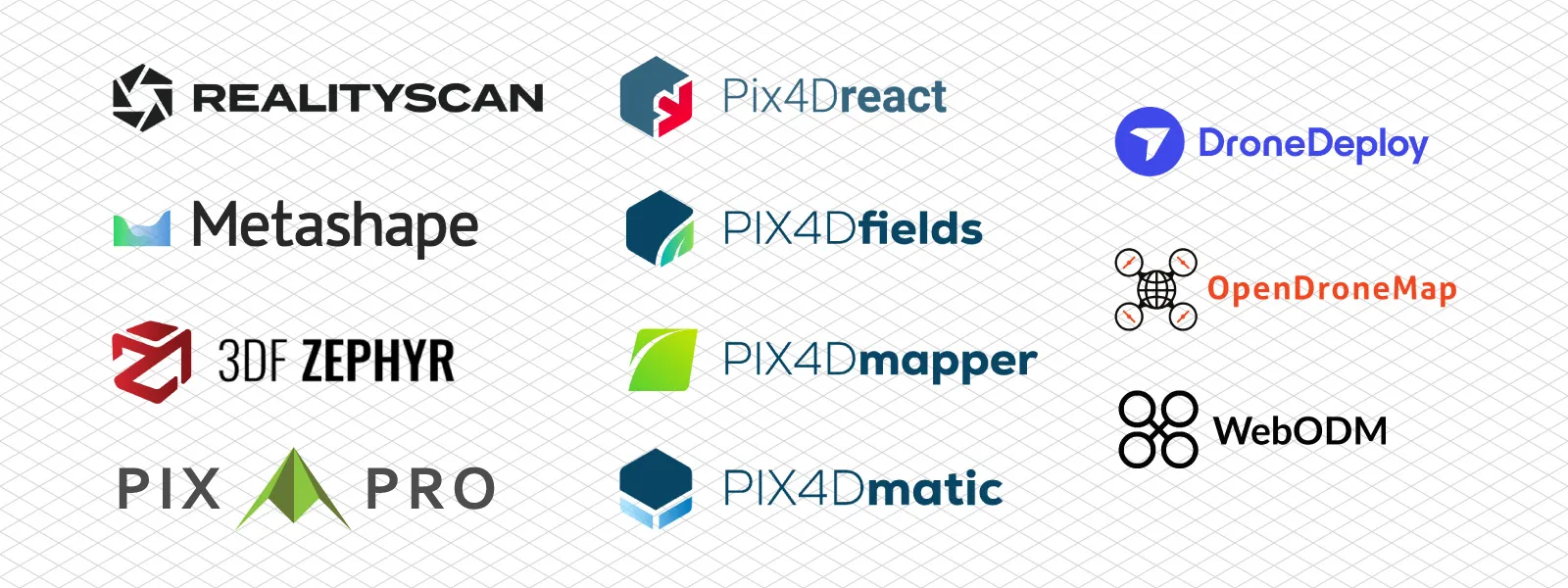
| Software | Price | How it is charged | Notable limit |
|---|---|---|---|
| RealityScan 2 | Free under 1M USD revenue | Free license | Revenue threshold |
| RealityScan 2 | 1,250 USD per seat | Per year | For companies over 1M USD revenue |
| Metashape Standard | 179 USD | One time, perpetual | No survey or georeferencing tools |
| Metashape Professional | 3,499 USD | One time, perpetual | Node locked to one machine |
| 3DF Zephyr Free | Free | Perpetual | 50 photos, limited export |
| 3DF Zephyr Lite | 199 EUR plus VAT | One time, perpetual | 1 year of updates included |
| 3DF Zephyr | 4,200 EUR plus VAT | One time, perpetual | 1 year of updates included |
| 3DF Zephyr | 250 EUR plus VAT per month | Subscription | Same software, rented |
| Pixpro Solo | 5 EUR per month | Annual billing (10 monthly) | 150 photos per project, cloud only |
| Pixpro Solo Plus | 25 EUR per month | Annual billing (50 monthly) | 300 photos per project |
| Pixpro Premium | 50 EUR per month | Annual billing (100 monthly) | 2,000 photos per project |
| Pix4Dreact | From 55 USD per month | Subscription | 2D only |
| Pix4Dfields | From 111 USD per month | Subscription | Agriculture focused |
| Pix4Dmatic | From 125 USD per month | Subscription | Large scale processing |
| Pix4Dmapper | From 333 USD per month | Subscription | Cloud sold separately |
| DroneDeploy Ag Lite | 1,908 USD per year | Annual billing | 1,000 images per map |
| DroneDeploy Individual | 4,188 USD per year | Annual billing | 3,000 images per map |
| WebODM / OpenDroneMap | Free | Open source | You host it yourself |
Zephyr and Pixpro publish in euros, everyone else in dollars. I have not converted anything, because rates move and I would rather quote each company as they quote themselves.
RealityScan Is Free for Most of You
This is the biggest change in photogrammetry pricing in years, and it does my own side no favors.
RealityCapture, long regarded as one of the fastest and most capable reconstruction engines available, was bought by Epic Games, rebranded RealityScan, and is now free for individuals and businesses under one million dollars in gross annual revenue. Students and educational institutions too. Not a limited version, not a watermarked export. All features. Above a million it is 1,250 dollars per seat per year, still less than a year of Pix4Dmapper.
 If you are a one person operation or a small survey firm, you can have a top tier engine for nothing. It leans toward reconstruction and visualization rather than survey deliverables, and it is the same corner of the market as Gaussian splatting, but "the good stuff is expensive" stopped being true.
What a Perpetual License Actually Is
Half this table is priced one way and half the other, and the word perpetual promises slightly more than it delivers.
 A perpetual license means you pay once and may keep using that software forever. No renewal, no license server, and it still opens in ten years. What "forever" does not cover is updates. Zephyr includes twelve months, after which you renew for another year at 20 percent of the license price. Skip it and nothing breaks, you just stay on the last version you were entitled to. So you own the version outright and rent the right to stay current.
Two related terms. Node locked means tied to one machine, which is how Metashape Professional is sold. Floating means it can move between machines in a company, usually through resellers and usually dearer.
A subscription inverts all of it: always current, always supported, and it stops the day the payment stops.
Perpetual Versus Subscription
Treat the numbers as fact and the last paragraph as argument.
The arithmetic. Zephyr sells the identical product both ways, which makes it the clean example: 250 euros a month is 3,000 a year, so the 4,200 euro license pays for itself at about seventeen months. Across vendors it is starker. Metashape Professional is 3,499 dollars once; Pix4Dmapper at 333 a month is roughly 12,000 over three years, with nothing to show at the end.
Perpetual wins on ownership. Nobody raises your price or changes your terms. It works with no internet and no license server phoning home, which matters on remote sites. If the vendor is acquired or folds, your copy still opens. Over several years of regular use it is simply cheaper.
Perpetual loses on the upfront number, which is large enough to need approval. Updates expire, so you either renew or fall behind as drone models and file formats move on. Support is thinner. Node locking makes hardware changes annoying. Cloud processing is rarely included, so a weak workstation turns a cheap license into an expensive problem.
 Subscription wins on entry cost, which is the honest reason most people start there. Always current, support included, and you can scale seats for a busy season and back down after. For one three month project, renting is obviously right. Cloud is often bundled.
Subscription loses on total cost, and you never stop paying. Prices rise at renewal. If processing lives in the vendor's cloud so does your data: DroneDeploy gives you thirty days of view-only access after you cancel, and Pix4D states they do not offer refunds.
My opinion. The industry moved to subscription because it produces predictable revenue for vendors, not because it serves customers better. That direction was decided in finance departments, not by users asking for it. If you process regularly and can afford the upfront cost, perpetual is usually the better deal, and it is getting harder to find. If your work is seasonal or you need cloud and a support line, subscription is rational and I would not argue.
Pixpro, for the record, is subscription only. So is most of this list.
What the Sticker Price Hides
Cloud sold separately. Pix4D lists PIX4Dcloud as its own product on top of a license. If your machine cannot process locally, that is a second purchase and your pricing page comparison was wrong. Pixpro includes cloud in every plan, including the five euro one. Worth pricing against a workstation build if you process often.
Image caps per project. Pixpro caps at 150, 300 and 2,000 photos by plan, Enterprise above that. DroneDeploy allows 3,000 images per map on the individual plan, 1,000 on agriculture. Check this before you check the price, because it is the limit most likely to stop you mid-job.
Fair usage policies. Anything described as unlimited and then footnoted is worth reading properly.
Refunds. Pix4D states in their own FAQ that they do not offer them. Cancelling stops the renewal, it does not return your money.
Your data on the way out. DroneDeploy gives you thirty days of view-only access after cancellation, with export disabled. If your deliverables live in someone else's cloud, the exit terms matter as much as the entry price.
Price Does Not Buy Accuracy
All of these run the same family of mathematics: structure from motion to solve the camera positions, then multi view stereo to build the surface. The differences are speed, interface, support and the extras bolted around the core. They are not in whether the geometry is correct.
 Accuracy comes from capture and control. Overlap, image quality, coverage, ground sampling distance and whether you used ground control points or RTK move your numbers far more than the logo on the window. A badly flown site in the most expensive software here loses to a well flown site in the free one. There is more on where accuracy comes from elsewhere on the blog, and none of it is about price.
Cheaper Alternatives to Pix4D
Pix4D is the name most people arrive with, so here is the short comparison against it.
 Pix4D vs Metashape. Metashape Professional is 3,499 dollars once against roughly 12,000 over three years for Pix4Dmapper. The trade is a steeper learning curve, no bundled cloud, and a 179 dollar Standard edition that drops the georeferencing tools survey work needs.
Pix4D vs RealityScan. Free under the revenue threshold and very fast on large image sets. It is built for reconstruction rather than survey deliverables, so measurement and reporting are weaker.
Pix4D vs 3DF Zephyr. The only vendor here still selling both ways. Lite at 199 euros is the cheapest serious perpetual license in the table.
Pix4D vs Pixpro. Cheapest of the paid options, cloud processing and flight planning included in every plan, capped by photos per project. My bias applies, see the disclosure at the top.
How to Choose Photogrammetry Software
How often will you use it? A few projects a year points at free or perpetual. Weekly use justifies a subscription with support.
How big are your projects? Count the photos in a typical job against the per-project caps. This disqualifies options faster than price does.
What are you producing? Measurements, volumes and orthophotos for a client need a tool built around measurement. A beautiful mesh for visualization is a different job, and RealityScan is very good at it.
Who operates it? Software only one person understands is a risk, not an asset. If your operator is a site manager rather than a surveyor, the gentler learning curve is worth real money, and the license may be the smaller number next to the training time.
Pixpro is where my bias lies: affordable end, Waypoints flight planning and cloud processing in every plan, built around measurements. Whether that fits depends on the four questions, not on my opinion.
Conclusion
You can pay nothing or you can pay four thousand dollars a year, and the core output is recognizably the same thing at both ends. What the money buys as the price climbs is cloud infrastructure, support, integrations, automation, and someone to call when a job is due tomorrow.
Work out which of those you need before you look at a price. Most people need fewer than the pricing pages assume, and now that the best known engine in the business is free below a threshold most readers sit under, the burden of proof is on everyone charging money. Pixpro included.
Frequently Asked Questions
What is the cheapest photogrammetry software in 2026?
Free, in two forms: RealityScan for anyone under one million dollars in annual revenue, and WebODM if you are willing to host it yourself. Among paid options, Metashape Standard at 179 dollars once and Pixpro Solo at 5 euros a month are the lowest entry points.
Is RealityCapture still available?
It was rebranded RealityScan 2 under Epic Games and the legacy licensing server has been shut down, so existing users need to move across. Free under one million dollars in revenue, 1,250 dollars per seat per year above it.
Is expensive photogrammetry software more accurate?
No. These packages use the same structure from motion and multi view stereo approach, so accuracy comes from your capture and control rather than the price. Overlap, image quality, coverage and ground control matter far more than software choice.
What is a perpetual license?
You pay once and may use that version forever, with no renewal and no license server. Updates are separate: Zephyr includes twelve months, then charges 20 percent of the license price per year to keep them coming.
Should I buy a perpetual license or a subscription?
It depends how often you process. Zephyr at 4,200 euros pays for itself against their own 250 euro monthly plan in about seventeen months, and Metashape Professional beats three years of a 333 dollar subscription comfortably. Subscription wins if your work is seasonal, if you need cloud bundled, or if the upfront sum is not realistic.
Does the price include cloud processing?
Not always, and it is the most common hidden cost. Pix4D sells cloud as a separate product. Pixpro includes it in every plan. Check before comparing any two prices.
What is the best cheap alternative to Pix4D?
It depends what you give up. RealityScan is free below one million dollars in revenue but is built for reconstruction rather than survey deliverables. Metashape and 3DF Zephyr are cheaper over several years because you buy them outright. Pixpro is the cheapest paid subscription and bundles cloud processing and flight planning, with a photo cap per project.
Photographer - Drone Pilot - Photogrammetrist. Years of experience in gathering data for photogrammetry projects, client support and consultations, software testing, and working with development and marketing teams. Feel free to contact me via Pixpro Discord or email (l.zmejevskis@pix-pro.com) if you have any questions about our blog.
Related Blog Posts
Our Related Posts
All of our tools and technologies are designed, modified and updated keeping your needs in mind

Most Asked Photogrammetry Questions Part 5 - From Capture to Delivery
We are back with another installment of our photogrammetry FAQ series. These are ten more questions we hear often, from people getting started and from users already deep into their projects.
 Pixpro Team
DJI Mini 5 Pro: Timed Shot During POI Tracking for Orbital Photogrammetry
Being able to run timed shot during POI tracking is a genuinely handy way to make quick orbital scans. Let me explain.
Pixpro Team
How to Make a Clean Roof Orthophoto for Solar Installations
Most roof scans are for a 3D model or a quick inspection. Every so often an engineer or a solar designer asks for something more specific: a true orthophoto of the roof, a straight top-down image they can measure and pull into their CAD workflow.
Pixpro Team
Ready to get started with your project?
You can choose from our three different plans or ask for a custom solution where you can process as many photos as you like!
Free 14-day trial. Cancel any time.